

Government will 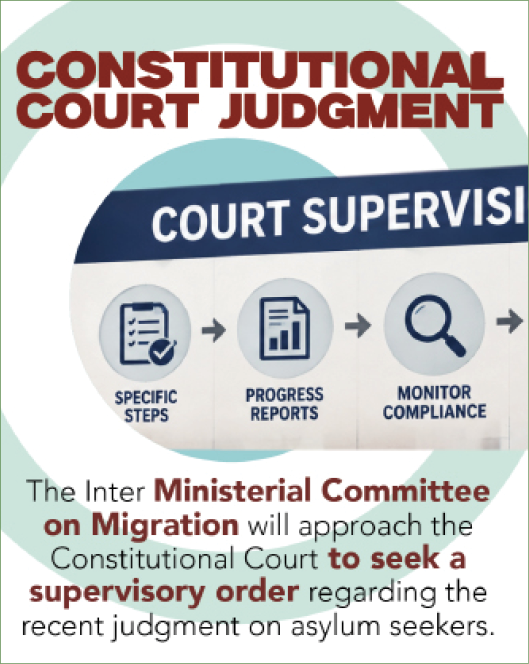 approach the courts for guidance on implementing the Constitutional Court judgment on the processing of asylum applications, while the Department of Home Affairs is expected to introduce a structured intention-registration and appointment system by 10 November 2026.
The Inter-Ministerial Committee (IMC) on Migration announced the measures recently in Pretoria during a media briefing, saying Government had considered the legal implications of the judgment handed down on 7 July 2026 and the administrative challenges arising from its implementation.
The court declared sections of the Refugees Act unconstitutional. These provisions allowed immigration officials to deport an asylum seeker who was in the country without a transit visa. A transit visa is issued at a port of entry to allow a person to travel to a refugee reception centre and apply for asylum.
Following legal consultations, Government has been advised that it can approach the courts for a supervisory order to oversee the implementation process and seek guidance on the measures required to give effect to the judgment.
“Accordingly, Government will request the Court to provide guidance on the nature and scope of the supervisory measures that may be required, as well as the appropriate duration of any suspension period necessary to build the operational capacity required for implementation.
“The objective is not to delay compliance, but to ensure effective and sustainable compliance that serves both the administration of justice and the broader public interest,” IMC Chair Mmamoloko Kubayi said.
The IMC said Government remained committed to upholding the Constitution, the rule of law and South Africa’s national and international obligations towards refugees and asylum seekers.
It also emphasised that Government remained legally bound to comply with the existing court order while pursuing further legal guidance.
“We are in a situation where the IMC must find a balance between compliance with the court order and listening to the concerns of many South Africans, and we believe we will be able to find that balance, though we need time and patience that we will request formally from the court and that we are requesting today from our citizens,” Kubayi said.
Structured asylum registration system
The Department of Home Affairs is expected to introduce a phased intention-registration and appointment model for asylum applications by 10 November 2026.
Under the proposed system, applicants will register their intention to seek asylum through an online platform and receive a receipt recording their personal particulars, biometric information, reference number and appointment at a Refugee Reception Office.
Assisted registration will be available at Refugee Reception Offices and, upon request, for people in police or immigration detention through officials, legal representatives and civil society partners.
The receipt will serve as proof that a person has declared an intention to seek asylum. It will not constitute a section 22 visa or recognition of refugee status.
According to the IMC, the system will operationalise legal protection against refoulement, the forced return of a person to a place where they may face persecution or serious harm, once a person declares an intention to seek asylum.
Home Affairs will instruct its officials and the Border Management Authority that holders of valid receipts must not be removed, refouled, arrested or detained solely for being in the country without a visa while their applications are being processed. The South African Police Service, Department of Correctional Services, National Prosecuting Authority and courts will also be informed of the arrangements.
The IMC clarified that the protection would apply only to people who had registered an intention to make a first asylum application. Rejected applicants will not be able to reactivate protection by declaring a new intention to apply, although genuinely new claims of persecution or serious harm may be considered before removal.
The system will also include confidentiality safeguards, protection of personal information, a complaints mechanism and published service standards.
“South Africa remains a constitutional democracy governed by the rule of law. Matters relating to asylum, migration and border management must be addressed through lawful processes and not through misinformation, intimidation, incitement, or acts of violence,” Kubayi said.
 Email
Email Facebook
 Twitter
 WhatsApp