


Two learner 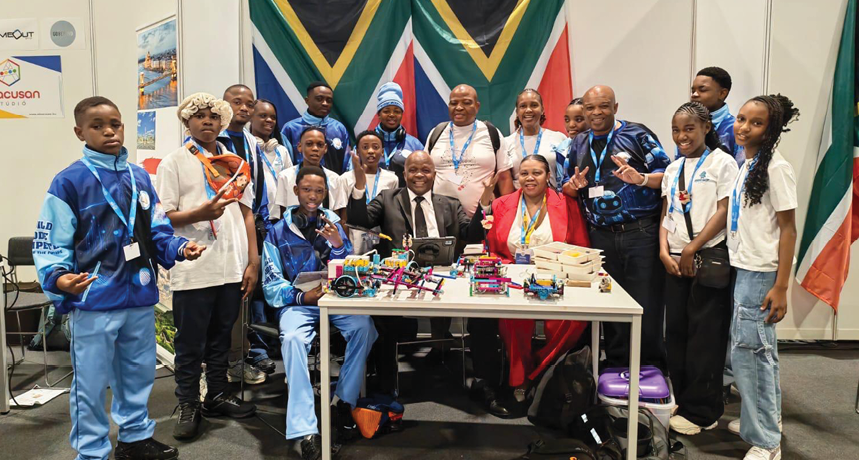 teams from Limpopo represented South Africa at the Robotics for Good Youth Challenge Grand Finale in Geneva, Switzerland.
Robo-Kidz from Mashupye Tladi Primary School and Roborise from Bokamoso Senior Secondary School competed from 7 to 10 July 2026 at the Palexpo International Exhibition and Convention Centre.
They reached the finale after progressing through local, provincial and national rounds, with Robo-Kidz winning the Junior Category and Roborise winning the Senior Category.
Bokamoso principal Titus Satlau said the school first distinguished itself against teams from Southern Africa.
“We competed against countries across Southern Africa, and we were selected as the top-performing school for coding and robotics,” said Satlau.
Seven learners from Grades 8 to 11 spent between four and six months developing an agricultural robot.
“We created a project for the agricultural sector. It is designed to make farming more efficient, with robots able to water plants and help ensure faster production. Instead of relying solely on manual labour, which can be time-consuming, the robot will enable quicker production,” Satlau said.
Based in Seshego, the technical school operates with limited resources.
“We are a Quintile 3 school, which means we lack resources. Our school has dilapidated buildings; we need proper infrastructure to allow these learners to achieve their full potential. We are an old school, but we are performing well in mathematics, science and technology,” Satlau said.
“This achievement is a significant milestone. When we started, we never thought we would go this far. The fact that the children were enthusiastic about the project tells us that through mathematics, science and technology, our learners can go places.”
Mashupye Tladi Primary School principal Mercy Kgomo led six learners from the 36-year-old Quintile 3 school, which is also based in Seshego.
“This is a great achievement for us as a school. I have a passionate teacher, Maphuthi Setumu, who loves coding and robotics; she is doing wonders with the learners.”
Both principals thanked the Department of Basic Education (DBE) for funding and organising the trip through the Mathematics, Science and Technology Conditional Grant.
DBE Acting Director for Communications Terence Khala said the achievement demonstrated the value of sustained investment in future-focused education.
“These learners are highlighting the best of South African education on the global stage. Their success proves what is possible when we invest in innovation, quality teaching and meaningful opportunities that allow young people to apply their knowledge to real-world challenges,” concluded Khala.
 Email
Email Facebook
 Twitter
 WhatsApp