


Shanghai, China - 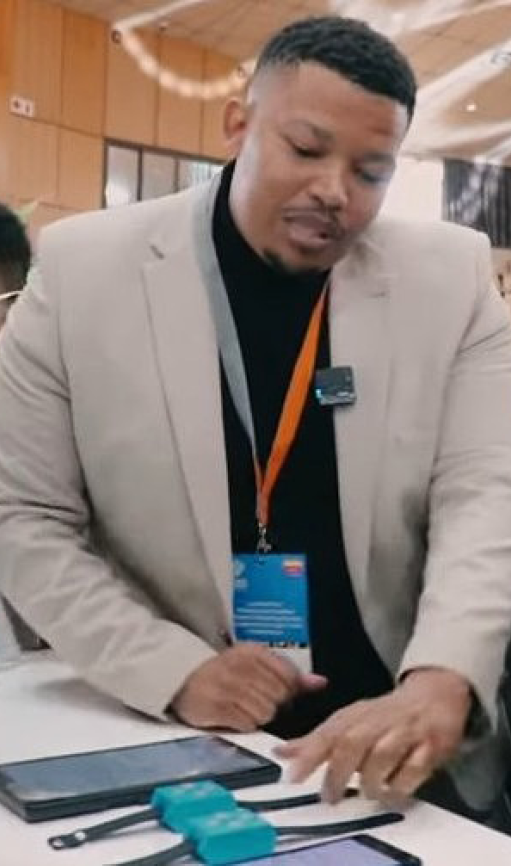 A Free State innovator who turned a friend's struggle to use a cellphone into an assistive technology solution is preparing to take his inve-ntion to the world.
In 2018, Tieho Tsiane developed Ka-Dah, a device that uses simple gestures and audio guidance to help people with disabilities navigate smartphones, organise applications and access messages independently.
Tsiane showcased the innovation at the 19th Pujiang Innovation Forum in Shanghai, China, where South Africa participated as the Country of Honour. He was part of the South African delegation as a beneficiary of funding from the Technology Innovation Agency (TIA).
The idea for Ka-Dah came after Tsiane witnessed the challenges faced by a friend living with ptosis, a condition that causes the upper eyelid to droop over one or both eyes, partially or completely obstructing vision.
“To use his phone, he literally has to hold his eyelid open because it automatically shuts itself. Over the years, this has put him at risk of eye damage and further injury,” Tsiane told Vuk'uzenzele at the Forum.
“I came up with this technology to assist him and ensure that he could still access his phone independently and communicate with other people.”
Ka-Dah combines hardware and software. The software allows users to operate their phones through gestures such as swiping down with two fingers or slowly swiping to the right with one finger. An onboarding function teaches users how to navigate the system.
Users can tap the back of the phone to activate audio guidance, which identifies the applications available within a category. The system also gives users greater control over when their private messages are read aloud.
Tsiane, who holds a degree in human resource management from the University of the Free State, acquired his technological knowledge through self-directed learning and innovation support programmes.
In 2020, TIA provided R260 000 to develop Ka-Dah's first prototype. Tsiane worked with the Central University of Technology's technology station and later received R300 000 from the SAB Foundation.
Support from TIA's Technology Acquisition and Deployment Fund subsequently enabled the production of 200 devices, which were distributed in the Free State and Gauteng for market testing.
“That process was critical because we needed to understand the challenges users were experiencing and determine whether the device was meeting their needs,” Tsiane said.
He is now seeking pre-commercialisation funding to refine the hardware, incorporate artificial intelligence into the software and scale Ka-Dah nationally.
 Email
 Facebook
 Twitter
 WhatsApp