


National 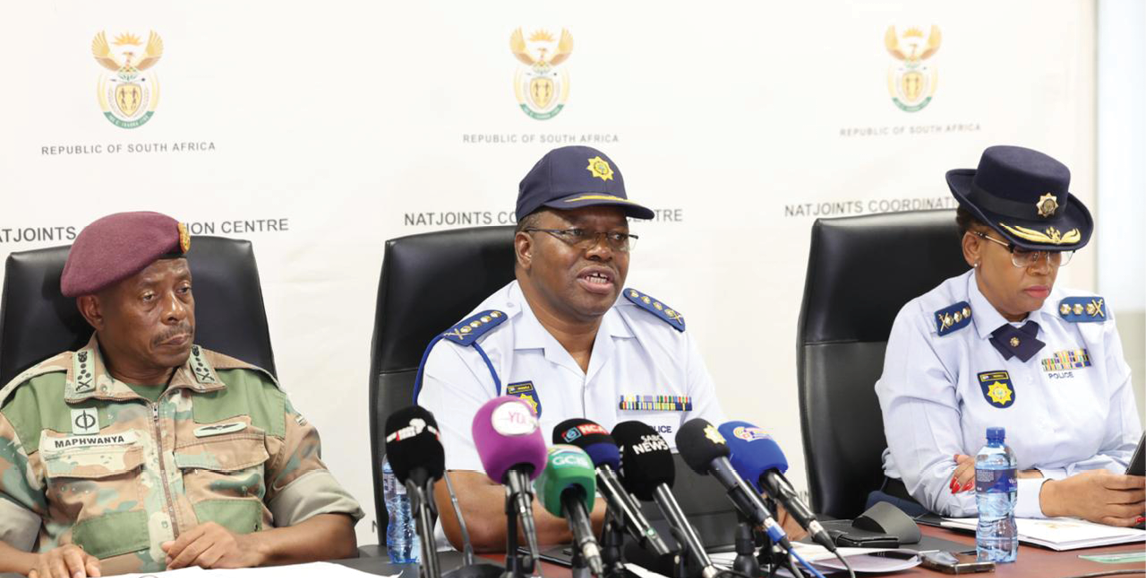 Commissioner of the South African Police Service (SAPS), Fannie Masemola, said the State will not allow criminality to prevail as government deploys the South African National Defence Force (SANDF) to support police in the fight against organised crime.
Speaking at a joint media briefing at the National Joint Operational and Intelligence Structure (NATJOINTS) Coordination Centre in Pretoria, Masemola said the joint intervention marks a significant step in strengthening the country’s response to violent crime and organised criminal networks.
Masemola addressed the briefing alongside Chief of the S A N D F General Rudzani Maphwanya, as well as NATJOINTS co-chairpersons Tebello Mosikili and Siphiwe Sangweni.
During the 2026 State of the Nation Address, President Cyril Ramaphosa announced the deployment of SANDF members under Operation Prosper, which will see more than 2 000 soldiers working alongside SAPS over a period of 13 months.
The intervention will focus on crime hotspots in several provinces, including the Free State, Gauteng, North West, Western Cape and Eastern Cape.
“These areas have been identified through intelligence and crime analysis as being significantly affected by criminal activity.
“The purpose of this intervention is to provide space to the South African Police Service to deal with both street crime and to disrupt, disable and dismantle organised crime groupings through a coordinated operational framework where the SANDF and SAPS will work together to stabilise crime-affected areas and restore the rule of law in communities where criminal networks have sought to undermine the authority of the State,” Masemola said.
Tackling illicit mining and gang violence
Masemola added that South Africa continues to face complex organised crime threats that destabilise communities.
In provinces such as the Free State, Gauteng and North West, organised criminal groups involved in illegal mining continue to exploit abandoned and active mining infrastructure, generating illicit financial flows and fuelling violence between rival groups.
At the same time, gang-related violence in the Western Cape, Eastern Cape and parts of Gauteng has contributed to high levels of murder, extortion, drug trafficking and the proliferation of illegal firearms.
“These criminal dynamics are not isolated. They are interconnected and often linked to illegal migration, illicit firearms trafficking, corruption networks and attacks on essential infrastructure.
“The scale, sophistication and persistence of these criminal activities have resulted in this extraordinary and integrated response by government. This is precisely what this joint deployment seeks to achieve,” he said.
Through coordinated operations, the SANDF will assist SAPS with enhanced visibility, targeted enforcement and stabilisation measures in identified hotspots.
Operational coordination will be managed through NATJOINTS, which will oversee intelligence-led planning and ensure cooperation among security agencies and government departments.
Joint Operational Centres have also been established to facilitate coordination between SAPS, SANDF and other law enforcement agencies.
Restoring safety in communities
Masemola said South Africans will begin to see increased visibility of security forces, intensified operations against illegal mining and gang activities, and strengthened protection of critical infrastructure.
“Success will therefore be measured not only in arrests or confiscations, but in the reduction of violence, the disruption of criminal networks and the restoration of community confidence,” he said.
Masemola called on communities to work with law enforcement agencies in the fight against crime, emphasising that public safety is a shared national responsibility.
“Working together, we will dismantle criminal networks, reclaim our communities from violence and lawlessness, and restore the sense of safety and dignity that every South African deserves.”
He also urged parents and guardians to take greater responsibility for the behaviour of their children amid growing concerns about young people, including children as young as 13, becoming involved in criminal activity.
 Email
Email Facebook
 Twitter
 WhatsApp