
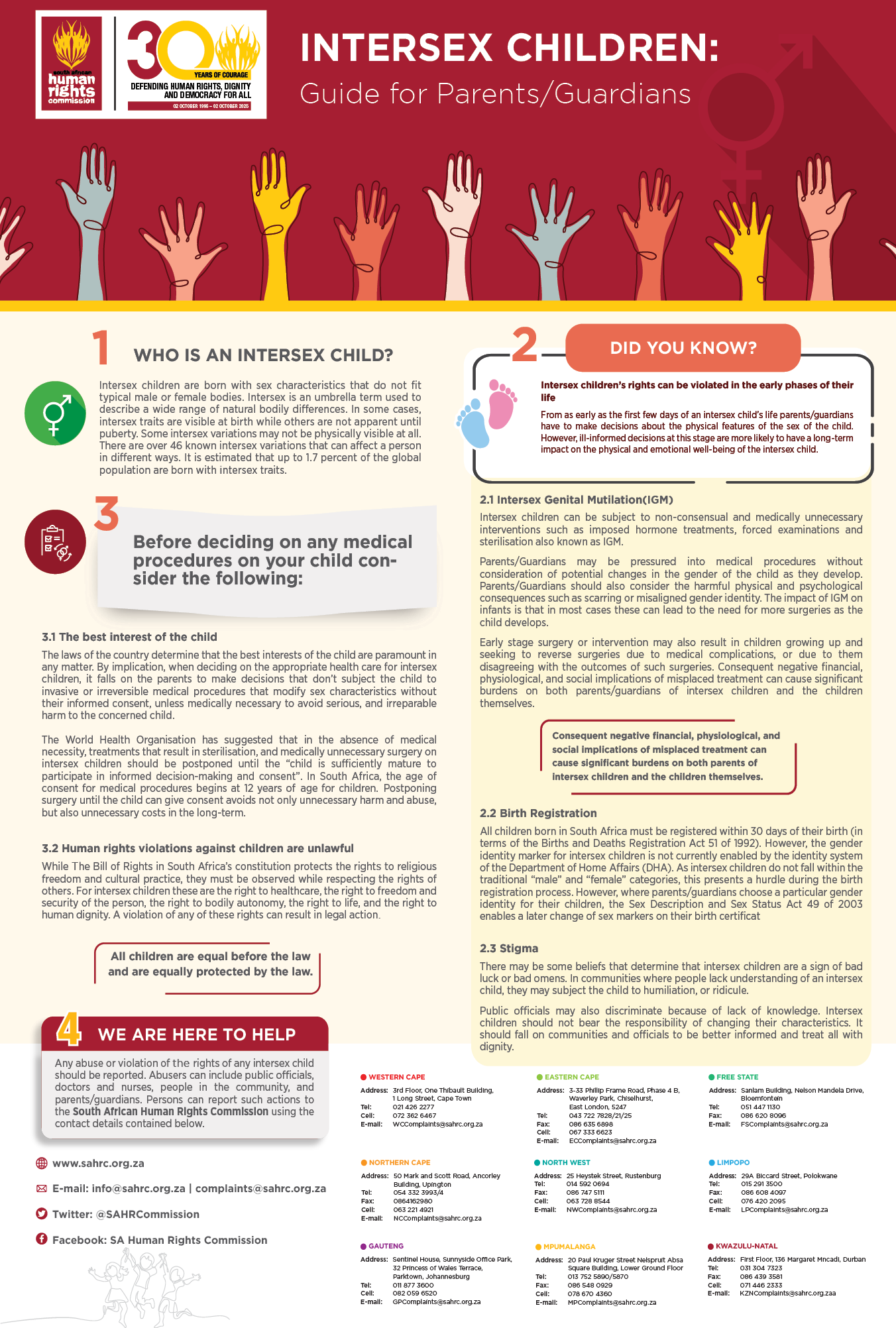
The South African Human Rights Commission has launched a national awareness campaign and educational guide to help parents protect the rights of intersex children.
The campaign, released during Freedom Month in April, responds to growing concern that intersex children remain vulnerable to misunderstanding, stigma and harmful medical decisions.
The Commission said society continues to overlook the inherent rights of intersex persons, especially children. The new guide, titled Intersex Children: Guide for Parents and Guardians, is aimed at families and healthcare providers.
Empowering parents
The Commission describes it as a tool for promoting these rights and empowering parents and guardians with information to best support their children.
The guide explains that intersex children are born with sex characteristics that do not fit traditional definitions of male or female bodies.
In some cases, the guide continues, intersex traits are visible at birth while others only become apparent at puberty. There are more than 46 known intersex variations, and estimates suggest that up to 1,7% of the global population is born with intersex traits.
A central concern of the campaign is the risk of early, permanent decisions made on behalf of children who cannot yet consent.
From the first days of an intersex child’s life, parents and guardians face decisions about the child’s physical characteristics. The Commission warns that poorly informed choices at this stage can have lasting effects on the child’s physical and mental health.
The guide cautions against unnecessary medical procedures, including interventions sometimes carried out before children are old enough to give consent.
These include imposed hormone treatments, forced examinations and sterilisation. The Commission warns that negative physical, financial and social consequences of misplaced treatment can place significant burdens on both the child and the family.
Prioritising the Child
Parents and guardians are encouraged to put the child’s wellbeing above social pressure or expectations. The Commission urges parents, guardians and healthcare facilities to share the materials widely and to report any abuse or rights violations.
Protecting the dignity and bodily autonomy of intersex children, it said, is both a legal and a moral responsibility.
For more information about the South African Human Rights Commission visit www.sahrc.org.za
 Email
Email Facebook
 Twitter
 WhatsApp